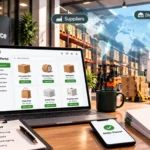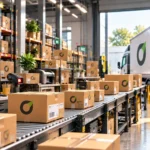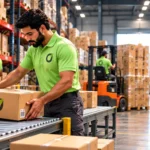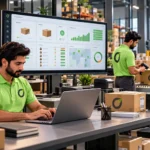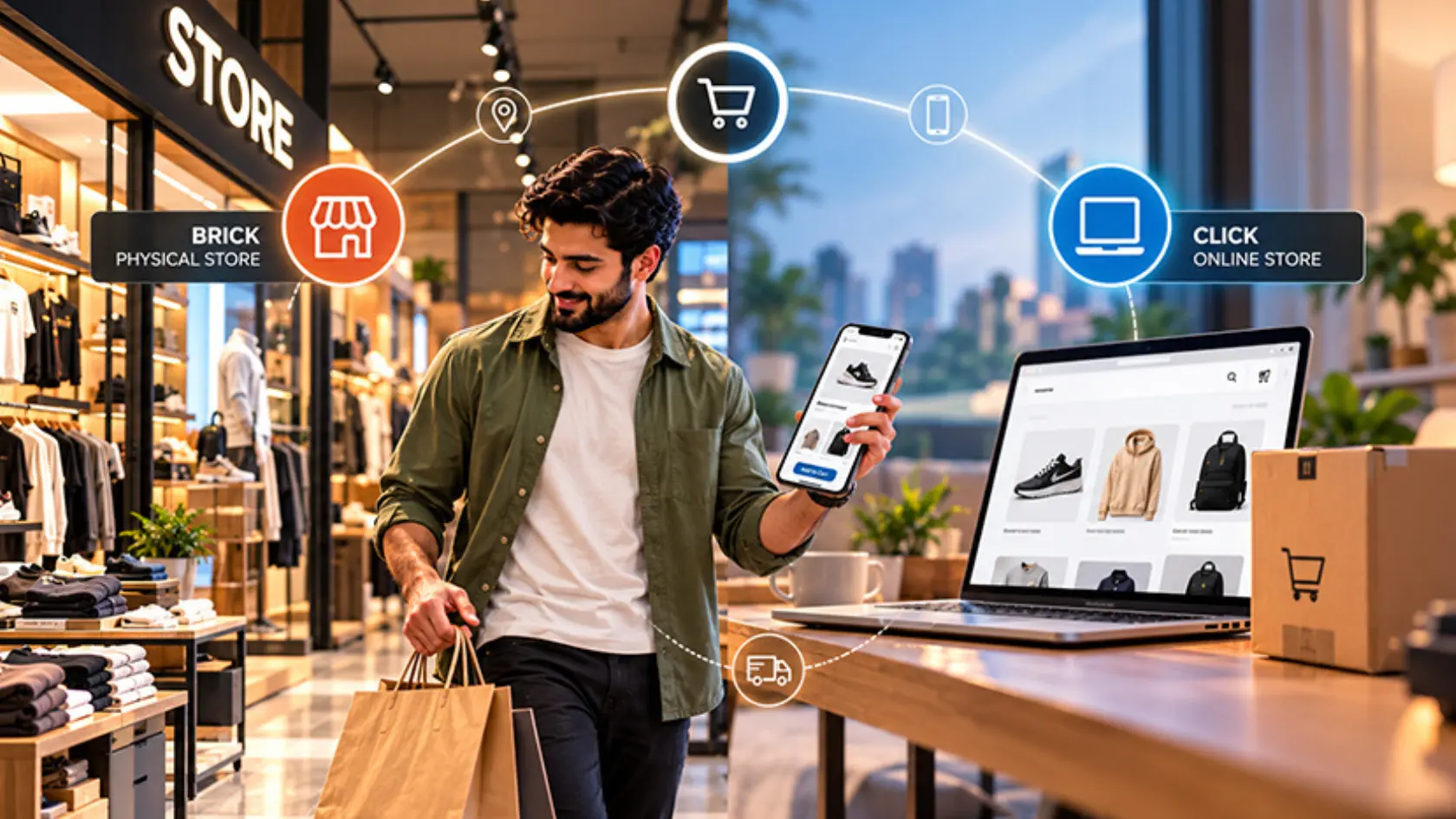
If you sell products both in physical stores and online, you’re already running a brick and click business – whether or not you’ve called it that. This guide breaks down exactly what the brick and click model means, why it consistently outperforms single-channel retail, and what operational systems (distribution, warehousing, and fulfillment) a brand actually needs to make it work in practice.
What Is Brick and Click?
Brick and click (also written “bricks and clicks” or “click and mortar”) is a hybrid retail business model that combines physical, in-store retail (“brick”) with an online, eCommerce presence (“click”), allowing customers to shop and receive service through both channels interchangeably.
A brick and click brand might let a customer browse products on a mobile app, buy online, and pick up in-store – or the reverse. The defining feature isn’t just “having a website plus a shop.” It’s that the two channels are operationally connected: shared inventory, shared customer data, and a shared fulfillment backbone.
What Is the Brick and Click Model?
The term “brick and click” describes any retail business that operates simultaneously through:
- Brick – physical retail infrastructure: stores, distributors, general trade outlets, and modern trade retail
- Click – digital retail infrastructure: websites, mobile apps, marketplaces (e.g., Daraz), and quick-commerce (q-commerce) platforms
Unlike a purely digital-native brand (Direct-to-Consumer only) or a traditional retailer with no online footprint, a brick and click business treats both channels as one unified system, not two separate businesses. This means:
- One inventory pool (or synchronized inventory across warehouses)
- Consistent pricing and promotions across channels
- A single customer view across in-store and online purchases
- Fulfillment infrastructure that can serve both retail shelves and last-mile home delivery
Entity note: Brick and click is closely related to omnichannel retail, click-and-collect, O2O (online-to-offline) commerce, and hybrid retail distribution – all are part of the same broader retail evolution away from single-channel selling.
Brick and Click vs. Brick and Mortar vs. Pure Click
| Model | Physical Presence | Online Presence | Inventory | Best For |
| Brick and Mortar | Yes | None/minimal | Store-only | Local, foot-traffic-dependent businesses |
| Pure Click (eCommerce-only) | None | Yes | Warehouse-only | Digital-native, DTC brands |
| Brick and Click | Yes | Yes | Shared/synchronized | Brands scaling across general trade, modern trade, and eCommerce |
The key differentiator is integration, not just presence. A store with a basic Facebook page isn’t truly brick and click. A brand where a customer can order online and return in-store, or where distributor stock and marketplace stock are managed from the same system, is.
Why the Brick and Click Model Works
The brick and click model works because it captures customers at every stage of the buying journey – research, convenience, trust, and speed – rather than forcing them into a single channel.
- Wider market reach – General trade and modern trade retail capture footfall and impulse buyers; eCommerce and q-commerce capture convenience-driven and digitally native shoppers.
- Higher customer trust – Physical retail presence builds brand credibility that pure-play online brands often struggle to establish, especially in emerging markets.
- Resilience against channel disruption – If online demand dips (e.g., algorithm or platform changes) or in-store footfall drops (seasonality, weather), the other channel cushions revenue.
- Better inventory efficiency – Shared warehousing and stock visibility across channels reduces overstock in one channel and stockouts in another.
- Data-driven decision-making – Combined online and offline sales data gives brands a fuller picture of demand, enabling better forecasting and merchandising.
- Flexible fulfillment options – Customers can choose home delivery, in-store pickup, or nearby retail purchase – a major driver of conversion and repeat purchase.
Real-World Examples of Brick and Click
- A consumer goods brand selling through general trade distributors, modern trade retail chains (supermarkets), and its own Shopify store simultaneously.
- An FMCG company listed on Daraz and other marketplaces while also maintaining shelf presence through a distributor network.
- A retail chain offering click-and-collect, where online orders are picked from the nearest store or fulfillment center rather than a central warehouse.
- A q-commerce-enabled brand using dark stores and micro-fulfillment centers to deliver within the hour, backed by the same inventory pool used for retail replenishment.
What It Takes to Run Brick and Click Operationally
This is where most brands underestimate the complexity. A brick and click strategy is easy to describe but operationally demanding – it requires four connected capabilities working together:
1. Distribution (Getting Products to Every Channel)
A brick and click brand needs distribution infrastructure covering:
- General trade distribution – distributor network management, retail coverage, order taking, merchandising coordination, and market execution to reach traditional retail outlets
- Modern trade distribution – key account management, listing management, promotion execution, store-level coordination, and trade marketing support for supermarkets and chains
- eCommerce distribution – channel management across pureplay and q-commerce retailers, inventory planning, order management, and marketplace account management
- Sales operations – sales team management, reporting, route planning, performance tracking, and demand forecasting to keep both channels stocked accurately
2. Warehousing (Keeping Inventory Channel-Ready)
Without synchronized warehousing, brick and click quickly breaks down into two disconnected businesses. This requires:
- Storage solutions – dedicated or shared warehousing depending on volume
- Inventory management – stock management, cycle counts, stock audits, and inventory reconciliation
- Compliance and quality – batch management, expiry management, FIFO/FEFO practices, and quality control checks
- Warehouse operations – inbound processing, putaway management, and outbound processing that can serve both bulk retail orders and single-unit eCommerce orders from the same facility
3. Fulfillment (Delivering to Both Retail and Consumers)
Fulfillment is the operational bridge between “brick” and “click.” It includes:
- eCommerce fulfillment – pick & pack, packaging, order processing, courier coordination, returns management, and last-mile delivery
- Marketplace fulfillment – Daraz fulfillment, Shopify fulfillment, WooCommerce fulfillment, and multi-channel fulfillment
- B2B fulfillment – distributor fulfillment, retail fulfillment, institutional orders, and bulk dispatches
- Reverse logistics – returns processing, damage management, and replacement handling
4. Value-Added Services (Channel-Specific Presentation)
Different channels often need differently packaged or labeled products:
- Packaging services – repacking, relabelling, barcode labelling
- Promotional services – bundling, gift packs, promotional packaging
- Quality services – inspection, quality checks, product sorting, and customer support
Common Challenges (and How to Solve Them)
What is the biggest challenge in running a brick and click business?
Inventory fragmentation – when stock for retail/distribution and stock for eCommerce/marketplaces are managed separately, leading to stockouts in one channel and overstock in another.
| Challenge | Root Cause | Solution |
| Stock mismatches between channels | Disconnected inventory systems | Centralized warehousing with real-time reconciliation |
| Slow or inconsistent delivery | No dedicated last-mile capability | Integrated fulfillment with last-mile coordination |
| Inconsistent product presentation | No channel-specific packaging process | Repacking, relabelling, and barcode labelling per channel |
| Poor demand forecasting | Siloed sales data | Combined sales reporting and demand forecasting across general trade, modern trade, and eCommerce |
| Returns handling delays | No reverse logistics process | Dedicated returns processing and replacement handling |
How Rholab Supports Brick and Click Brands
Building a true brick and click operation isn’t just a strategy decision – it’s a supply chain execution challenge. This is exactly where Rholab fits in.
Rholab provides the end-to-end infrastructure that lets brands run brick and click without managing two disconnected supply chains. That includes general trade and modern trade distribution, eCommerce and marketplace distribution (including Daraz, pureplay, and q-commerce retailers), dedicated and shared warehousing with full inventory and compliance management, and fulfillment services spanning eCommerce, marketplace (Daraz, Shopify, WooCommerce), B2B, and reverse logistics – with last-mile delivery handled through Rhofleet.
In practice, this means a brand can list a product on a marketplace, stock it in general trade outlets, and sell it in modern trade retail – all from one synchronized inventory and fulfillment system managed by Rholab, rather than juggling separate vendors for each channel.
Need a Quick Answer?
Q1. What does “brick and click” mean in business?
Brick and click refers to a business model where a company operates both physical retail channels (brick) and online/digital sales channels (click) in an integrated way, sharing inventory, data, and fulfillment infrastructure across both.
Q2. Is brick and click the same as omnichannel retail?
They’re closely related. Brick and click describes having both physical and digital channels; omnichannel retail describes how seamlessly those channels are connected for the customer experience. A brand can be brick and click without being fully omnichannel if the channels aren’t well integrated.
Q3. What’s the difference between brick and click and click and mortar?
None – they’re the same concept with different word order. Both describe a hybrid retail model combining physical stores with online sales.
Q4. Why do brands adopt a brick and click strategy?
To reach more customers, reduce dependency on a single sales channel, build trust through physical presence, and use combined sales data for better inventory and demand planning.
Q5. What operational systems does a brick and click business need?
At minimum: distribution (general trade, modern trade, and eCommerce), warehousing with synchronized inventory, fulfillment for both retail and direct-to-consumer orders, and value-added services like packaging and labelling for channel-specific presentation.
Q6. Can a small brand run a brick and click model?
Yes. Many brands start with shared warehousing and outsourced distribution/fulfillment partners (rather than building in-house infrastructure) to run a brick and click model cost-effectively before scaling.
Q7. How does inventory work in a brick and click business?
Ideally, inventory is centralized or synchronized in real time across warehouses, so stock allocated to distributors, retail stores, and online orders is visible and adjustable from one system – preventing stockouts in one channel while another is overstocked.
Let’s Sum It Up
The brick and click model isn’t a trend – it’s the operational reality for most retail and consumer brands today. Customers expect to move fluidly between physical stores, marketplaces, and direct online purchases, and brands that can’t support that flexibility lose sales to those that can. The real differentiator isn’t whether a brand sells in both channels, but whether its distribution, warehousing, and fulfillment systems are built to support both without friction.
Ready to run a true brick and click operation? Rholab handles the distribution, warehousing, fulfillment, and value-added services that connect your physical retail and digital channels into one system – so your brand can scale across general trade, modern trade, and eCommerce without operational silos. Talk to Rholab about your brick and click strategy →