Packaging services determine how products look, function, and get identified as they move through the supply chain. Whether products need to be repacked for a new market, relabelled for compliance, or barcoded for tracking, the right packaging service keeps everything organized and accurate. This guide explains what packaging services are, why they matter, and how to manage them effectively.
What Are Packaging Services?
Packaging services refer to the processes involved in preparing, modifying, or labeling products so they meet market, retailer, or operational requirements before storage, distribution, or sale. This includes repacking products into different formats, relabelling for compliance or branding, and applying barcodes for tracking.
In simple terms: packaging services are how a business makes sure every product is correctly packed, labeled, and identifiable before it moves further down the supply chain.
These services are especially important for businesses handling multiple product variations, entering new markets, or supplying retailers with specific packaging requirements.
Why Packaging Services Matter
Packaging services matter because incorrect or non-compliant packaging can delay shipments, cause retailer rejections, or create confusion in inventory tracking. Strong packaging services help businesses:
- Meet retailer and marketplace packaging requirements
- Stay compliant with labeling regulations across different markets
- Enable accurate tracking and inventory management through barcoding
- Adapt products quickly for new bundles, promotions, or markets
- Reduce errors caused by mislabeled or incorrectly packaged stock
Without effective packaging services, businesses risk shipment delays, compliance issues, and inventory tracking errors that ripple through the rest of the supply chain.
Key Components of Packaging Services
Managing packaging services well requires three core components working together, each addressing a different aspect of how products are prepared before they move forward in the supply chain.
Repacking
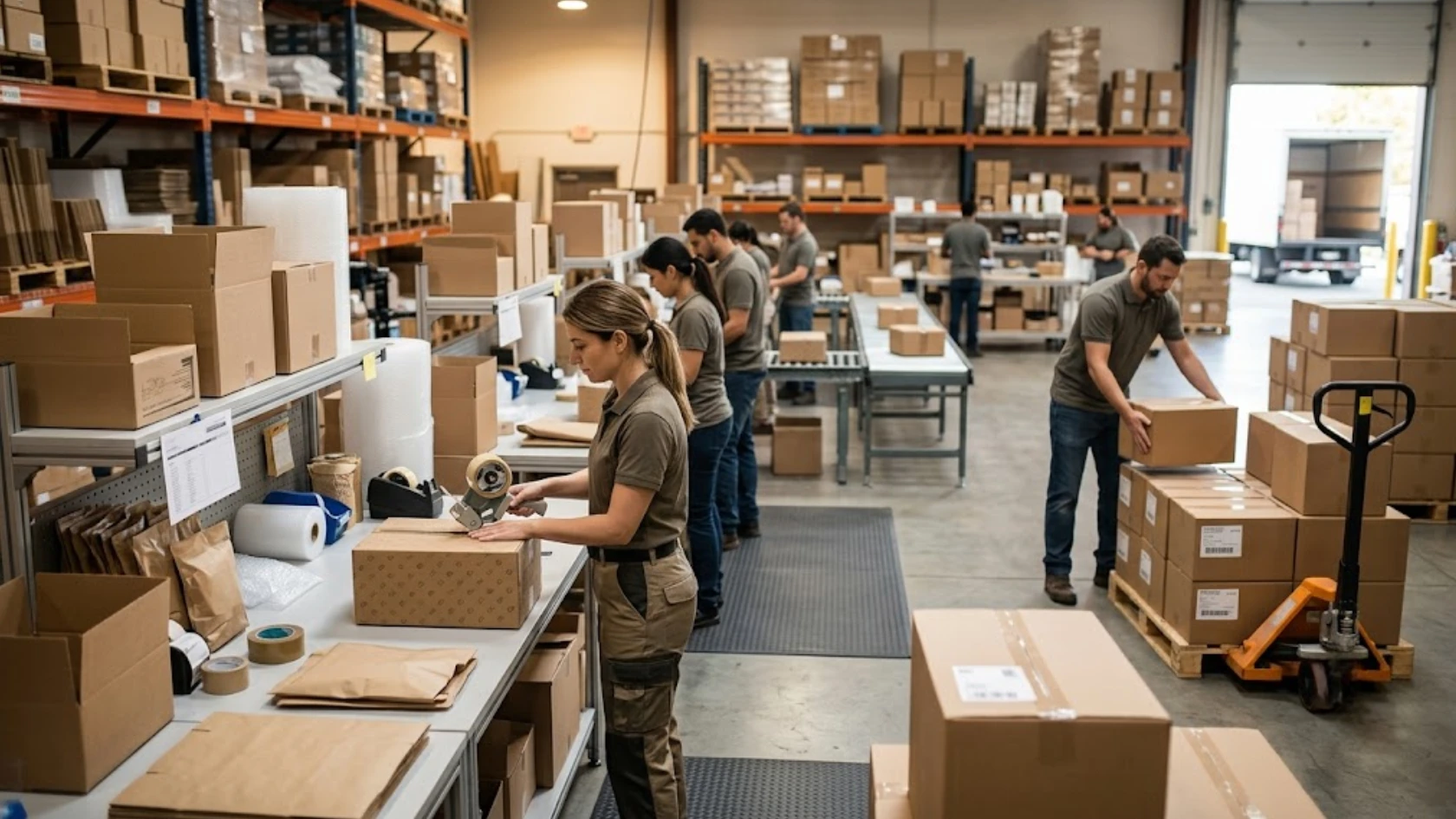
Repacking is the foundation of packaging services. It involves changing a product’s original packaging into a new format, whether that means combining items into bundles, splitting bulk packaging into smaller units, or adapting packaging for a specific retailer or market.
Good repacking includes:
- Converting bulk stock into retail-ready units
- Creating product bundles or promotional packs
- Adapting packaging formats to meet specific retailer requirements
- Maintaining product quality and protection during the repacking process
- Keeping accurate records of repacked stock and quantities
Efficient repacking allows businesses to adapt quickly to different sales channels and customer needs without waiting on new packaging from suppliers.
Relabelling
Relabelling involves replacing or updating a product’s existing labels with new ones, often to meet compliance requirements, correct errors, update pricing, or prepare products for a different market.
Effective relabelling includes:
- Updating labels to meet local regulatory or language requirements
- Correcting pricing, batch, or expiry information when needed
- Applying retailer-specific labeling standards
- Ensuring old labels are fully removed or covered to avoid confusion
- Verifying label accuracy before products move to storage or dispatch
Accurate relabelling ensures products remain compliant and clearly identifiable, no matter which market or retailer they are headed to.
Barcode Labelling
Barcode labelling involves applying barcodes to products or packaging so they can be scanned and tracked accurately throughout the supply chain. Barcodes are essential for inventory management, order processing, and point-of-sale systems.
Good barcode labelling includes:
- Applying accurate, scannable barcodes to each product unit
- Matching barcodes correctly to inventory and system records
- Following retailer or marketplace-specific barcode formatting requirements
- Verifying barcode quality to prevent scanning errors
- Updating barcodes when product details or packaging change
Reliable barcode labelling supports accurate inventory tracking, faster order processing, and fewer errors throughout storage and fulfillment.
Common Challenges in Packaging Services
Packaging services come with real challenges, especially when handling products across multiple markets or retail partners:
- Inconsistent packaging standards: different retailers or markets requiring different formats
- Labeling errors: incorrect or outdated information leading to compliance issues
- Barcode mismatches: barcodes not matching system records, causing scanning or tracking errors
- Slow turnaround times: manual repacking and relabelling processes creating delays
- Quality control gaps: packaging changes made without proper verification steps
These challenges are exactly why more businesses are turning to structured processes and technology to manage their packaging services.
How Technology Improves Packaging Services
Technology has changed how businesses manage packaging services. Instead of relying on manual, disconnected processes, businesses now use digital tools to standardize and verify packaging, labeling, and barcoding accurately.
Technology helps by:
- Standardizing repacking workflows across different product lines
- Automating label generation to reduce manual errors
- Verifying barcode accuracy before products move to storage or dispatch
- Providing real-time tracking of repacked and relabelled stock
- Ensuring compliance with retailer and market-specific packaging requirements
This shift toward more structured, technology-supported packaging services helps businesses reduce errors and move products through the supply chain faster.
How Rholab Helps with Packaging Services
Rholab supports businesses in managing every part of their packaging services, from repacking to barcode labelling. Rholab’s approach focuses on giving businesses accurate, compliant packaging and labeling processes that keep products moving smoothly through storage and distribution.
By bringing repacking, relabelling, and barcode labelling into one connected process, Rholab helps businesses meet retailer requirements, stay compliant, and maintain accurate tracking across their supply chain.
Find the Answers You’re Looking For
Q1. When does a business need packaging services?
Businesses typically need packaging services when entering new markets, supplying different retailers with specific requirements, correcting labeling errors, or preparing products for promotions and bundles.
Q2. What types of products can benefit from professional packaging services?
Professional packaging services are suitable for a wide range of products, including eCommerce orders, electronics, medical devices, industrial equipment, food products, cosmetics, retail goods, and fragile or high-value items. Customized packaging solutions can be tailored to meet the specific requirements of almost any industry.
Q3. What is included in a complete packaging service?
A complete packaging service typically includes product assessment, custom packaging design, protective packaging, labeling, barcoding, kitting, assembly, shrink wrapping, palletizing, and shipping preparation. Some providers also offer warehousing, fulfillment, and logistics support for end-to-end supply chain management.
Q4. How do custom packaging services help businesses save money?
Custom packaging services help businesses reduce shipping expenses by optimizing package size and weight while minimizing product damage during transit. Efficient packaging also lowers return rates, reduces material waste, and improves operational efficiency, leading to long-term cost savings.
Q5. Can packaging services be customized for different industries?
Yes. Packaging services can be customized for industries such as manufacturing, healthcare, food and beverage, pharmaceuticals, automotive, electronics, retail, and eCommerce. Industry-specific packaging solutions ensure products meet safety standards, regulatory requirements, and customer expectations.
Q6. How do packaging services protect fragile or high-value products during shipping?
Professional packaging services use protective materials such as foam inserts, bubble wrap, corrugated boxes, molded packaging, cushioning materials, and secure sealing techniques. These solutions help prevent damage caused by vibration, moisture, impact, and handling during transportation.
Q7. Are eco-friendly packaging services available?
Yes. Many packaging service providers offer sustainable packaging solutions using recyclable, biodegradable, compostable, and reusable materials. Eco-friendly packaging helps businesses reduce their environmental impact while meeting growing customer demand for sustainable products and packaging practices.
Q8. What should I consider when choosing a packaging service provider?
When selecting a packaging service provider, consider their industry experience, customization capabilities, quality control processes, packaging materials, turnaround time, scalability, pricing, sustainability options, and ability to support shipping and logistics requirements. Choosing the right provider ensures reliable product protection and consistent packaging quality.
Q9. How do packaging services improve customer satisfaction?
Well-designed packaging enhances the customer experience by protecting products, improving presentation, and creating a positive first impression. Secure, attractive packaging reduces the likelihood of damaged deliveries while strengthening brand trust and encouraging repeat purchases.
Q10. How can I choose the right packaging solution for my business?
The right packaging solution depends on your product size, weight, fragility, shipping method, storage conditions, branding goals, and budget. A professional packaging service provider can assess your specific needs and recommend customized packaging solutions that balance product protection, cost efficiency, and sustainability.
Let’s Get Started
Packaging services play an important role in making sure products are correctly formatted, labeled, and trackable as they move through the supply chain. Success in this area depends on efficient repacking, accurate relabelling, and reliable barcode labelling.
Businesses that manage these components well stay compliant, reduce errors, and keep their products moving smoothly from warehouse to shelf.
If you want to strengthen your packaging services and get better accuracy across repacking, relabelling, and barcode labelling, Rholab can help you build a more connected and reliable packaging process. Reach out to Rholab today to see how better packaging services can grow your business.