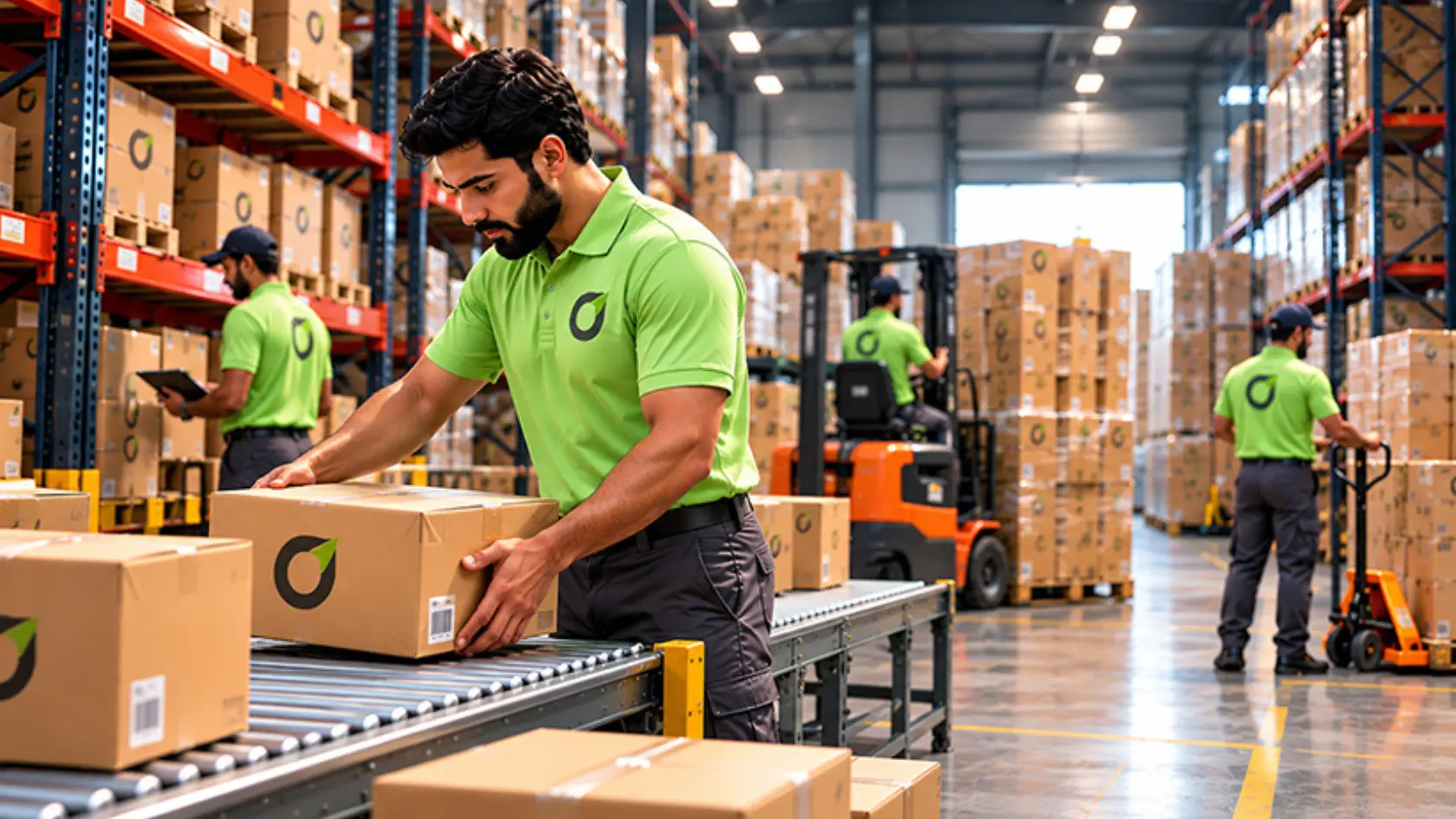
Warehousing is the business function of storing, managing, and controlling physical goods – including inbound receiving, putaway, inventory tracking, quality control, and outbound dispatch – between the point of production and the point of sale or delivery. Modern warehousing goes beyond storage; it includes inventory accuracy, compliance (FIFO/FEFO), and integration with distribution and fulfillment to keep supply chains moving efficiently.
Warehousing sits at the center of every supply chain. Whether you’re a manufacturer, a distributor, or a fast-growing eCommerce brand, how you store and manage inventory directly affects order accuracy, delivery speed, and customer satisfaction. This guide breaks down everything you need to know about warehousing – what it is, the types available, how it works, and how to choose the right warehousing partner.
What Is Warehousing?
Warehousing refers to the storage and management of raw materials, semi-finished, or finished goods in a designated facility before they are distributed, sold, or delivered to end customers. A warehouse acts as a buffer between supply and demand, allowing businesses to hold stock, manage seasonal fluctuations, and fulfill orders efficiently.
Warehousing is a core pillar of logistics and supply chain management (SCM), closely linked to related functions such as inventory management, order fulfillment, distribution, and last-mile delivery.
Key entities associated with warehousing:
- Storage facilities (dedicated and shared warehouses)
- Inventory management systems (IMS/WMS)
- Inbound and outbound logistics
- Quality control and compliance (batch, expiry, FIFO/FEFO)
- Distribution and fulfillment networks
Why Warehousing Matters in a Supply Chain
Effective warehousing impacts nearly every part of a business’s operations:
- Order accuracy – Proper storage and inventory control reduce picking errors.
- Faster fulfillment – Well-organized warehouses shorten the time between order placement and dispatch.
- Cost control – Reduces overstocking, understocking, and product wastage (especially for perishable or expiry-sensitive goods).
- Business continuity – Buffer stock protects against supply disruptions and demand spikes.
- Compliance – Regulated industries (FMCG, pharma, food) require batch tracking and expiry management to meet quality standards.
- Scalability – Businesses can expand into new markets or sales channels without investing in their own infrastructure.
Types of Warehousing
Dedicated Warehousing
A single business has exclusive use of a facility (or a defined space within one). This offers greater control, customization, and consistency – ideal for brands with high or steady volume.
Shared Warehousing
Multiple businesses share warehouse space, equipment, and staff, splitting fixed costs. This is a cost-effective option for growing businesses or those with seasonal/variable demand.
Public Warehousing
Independently owned facilities that lease space to multiple businesses on a short-term or flexible basis, typically without long-term contractual commitment.
Private Warehousing
Owned and operated directly by a manufacturer, distributor, or retailer for their own exclusive use.
Bonded Warehousing
Government-regulated facilities used to store imported goods before customs duties are paid – common in cross-border trade.
Distribution Centers
Warehouses optimized for high-velocity inbound and outbound flow, focused on moving goods to retailers, distributors, or stores rather than long-term storage.
Fulfillment Centers
Warehouses designed specifically to pick, pack, and ship individual customer orders – the backbone of eCommerce and D2C (direct-to-consumer) operations.
Cold Storage / Temperature-Controlled Warehousing
Specialized facilities for perishable goods, pharmaceuticals, and temperature-sensitive products requiring refrigeration or climate control.
Core Warehousing Functions and Processes
A well-run warehouse operation typically includes:
- Inbound Processing – Receiving, inspecting, and verifying incoming stock against purchase orders.
- Putaway Management – Systematically placing goods into designated storage locations for efficient retrieval.
- Stock/Inventory Management – Ongoing tracking of stock levels, locations, and movement.
- Cycle Counts & Stock Audits – Regular partial or full inventory checks to catch discrepancies early and maintain accuracy.
- Inventory Reconciliation – Matching physical stock counts with system records to correct variances.
- Batch and Expiry Management – Tracking batch numbers and expiry dates, critical for FMCG, food, and pharma products.
- FIFO / FEFO – First-In-First-Out or First-Expired-First-Out picking methods that reduce spoilage and obsolescence.
- Quality Control Checks – Inspecting goods for damage, defects, or non-compliance before storage or dispatch.
- Outbound Processing – Picking, staging, and dispatching goods for distribution, retail, or direct fulfillment.
Warehousing vs. Distribution vs. Fulfillment
These three terms are often used interchangeably, but they serve distinct roles:
| Function | Primary Focus | Typical Use Case |
| Warehousing | Storing and managing inventory | Holding stock safely and accurately before it moves |
| Distribution | Moving bulk stock to retailers/distributors | General trade, modern trade, and B2B supply chains |
| Fulfillment | Picking, packing, and shipping individual orders | eCommerce, marketplace, and D2C order delivery |
In practice, warehousing is the foundation that both distribution and fulfillment depend on – accurate storage and inventory control make downstream delivery possible.
Benefits of Outsourcing Warehousing to a 3PL
Partnering with a third-party logistics (3PL) provider for warehousing offers several advantages over managing storage in-house:
- Lower capital investment – No need to build or lease your own facility.
- Operational expertise – Trained teams handling inventory, compliance, and quality control.
- Scalability – Easily expand or contract storage space based on demand.
- Technology access – Warehouse management systems (WMS) and inventory visibility without upfront tech investment.
- Focus on core business – Free up internal resources to focus on sales, product, and growth rather than logistics operations.
- Multi-channel readiness – Support for general trade, modern trade, eCommerce, and marketplace fulfillment from one location.
How to Choose the Right Warehousing Partner
When evaluating a warehousing or 3PL provider, consider:
- Storage flexibility – Do they offer both dedicated and shared warehousing options?
- Inventory accuracy practices – Are cycle counts, stock audits, and reconciliation done regularly?
- Compliance capability – Can they manage batch tracking, expiry dates, and FIFO/FEFO for regulated products?
- Technology integration – Does their system integrate with your ERP, POS, or eCommerce platforms?
- Geographic coverage – Are their facilities positioned to support your distribution and last-mile delivery needs?
- Value-added services – Can they support repacking, relabelling, barcode labelling, or promotional packaging?
- Track record – Ask for client references and experience across your specific industry (FMCG, retail, eCommerce, etc.).
Warehousing Technology and Trends
Modern warehousing increasingly relies on:
- Warehouse Management Systems (WMS) for real-time inventory visibility
- Barcode and RFID tracking for faster, more accurate stock movement
- Demand forecasting tools to optimize stock levels and reduce holding costs
- Automation and robotics in high-volume picking and sorting operations
- Data-driven route and inventory planning connecting warehousing directly to distribution and last-mile delivery
Common Warehousing Challenges (and Solutions)
| Challenge | Solution |
| Inventory inaccuracy | Regular cycle counts and stock audits with reconciliation |
| Product spoilage/expiry loss | FIFO/FEFO discipline and batch/expiry tracking |
| Slow order processing | Optimized putaway and outbound workflows |
| Limited scalability | Shared warehousing model for flexible space |
| Compliance risks | Structured quality control checks at every stage |
| Poor multi-channel visibility | Centralized inventory management across sales channels |
How Rholab Supports Businesses with Warehousing
Rholab provides end-to-end warehousing solutions designed to give businesses accurate, compliant, and scalable storage – without the overhead of managing it in-house. Rholab’s warehousing services include:
- Storage Solutions – Dedicated Warehousing and Shared Warehousing options tailored to business size and demand.
- Inventory Management – Stock management, cycle counts, stock audits, and inventory reconciliation to keep records accurate.
- Compliance & Quality – Batch management, expiry management, FIFO/FEFO practices, and quality control checks for regulated and fast-moving goods.
- Warehouse Operations – Structured inbound processing, putaway management, and outbound processing for smooth stock flow.
Because warehousing connects directly to distribution and fulfillment, Rholab pairs its warehousing solutions with distribution solutions (general trade, modern trade, eCommerce distribution, sales operations), fulfillment solutions (eCommerce, marketplace, B2B, and reverse logistics), and value-added services (repacking, relabelling, barcode labelling, and quality inspection) – giving businesses a single, integrated supply chain partner rather than a patchwork of vendors.
Let’s Answer Your Questions
Q1. What is warehousing in simple terms?
Warehousing is the process of storing goods safely in a facility until they are needed for sale, distribution, or delivery. It includes receiving stock, organizing it, tracking inventory, and preparing it for dispatch.
Q2. What is the difference between a warehouse and a distribution center?
A warehouse is primarily focused on storing goods, while a distribution center is optimized for fast-moving inbound and outbound flow to retailers or distributors, with less emphasis on long-term storage.
Q3. What is the difference between dedicated and shared warehousing?
Dedicated warehousing gives one business exclusive use of a facility or space, offering more control and customization. Shared warehousing splits space and costs among multiple businesses, making it more cost-effective for lower or variable volumes.
Q4. What is FIFO and FEFO in warehousing?
FIFO (First-In-First-Out) means the oldest stock is sold or used first. FEFO (First-Expired-First-Out) prioritizes items closest to their expiry date, which is critical for perishable or date-sensitive products like food and pharmaceuticals.
Q5. Why should a business outsource warehousing to a 3PL?
Outsourcing warehousing reduces capital investment, gives access to trained staff and warehouse technology, and allows businesses to scale storage up or down based on demand – without managing facilities directly.
Q6. What is included in warehouse inventory management?
Warehouse inventory management typically includes stock management, cycle counts, stock audits, and inventory reconciliation to ensure recorded stock levels match physical stock accurately.
Q7. How does warehousing support eCommerce businesses?
Warehousing provides the storage and inventory accuracy that eCommerce fulfillment depends on – enabling faster pick-and-pack, accurate order processing, and reliable stock availability across online sales channels.
Q8. What industries need specialized warehousing?
Industries dealing with perishable, temperature-sensitive, or regulated goods – such as FMCG, food and beverage, and pharmaceuticals – need specialized warehousing with batch management, expiry tracking, and quality control.
Q9. How is warehousing different from fulfillment?
Warehousing focuses on storing and managing inventory, while fulfillment focuses on picking, packing, and shipping individual customer orders. Fulfillment relies on accurate warehousing to operate efficiently.
Q10. How do I choose the right warehousing provider?
Look for storage flexibility, strong inventory accuracy practices, compliance capabilities (batch/expiry/FIFO-FEFO), technology integration, and value-added services like repacking or labelling, backed by a proven operational track record.
Final Considerations
Warehousing is far more than storing boxes on shelves – it’s a strategic function that shapes inventory accuracy, order speed, compliance, and ultimately customer satisfaction. Whether you’re managing general trade distribution, scaling an eCommerce brand, or handling B2B bulk orders, the right warehousing setup – dedicated or shared, technology-enabled, and compliance-ready – is what keeps your supply chain resilient and efficient.
Rholab brings together warehousing, distribution, fulfillment, and value-added services under one roof, so businesses don’t have to stitch together multiple vendors to keep goods moving accurately and on time.
Ready to simplify your warehousing?
Talk to Rholab about dedicated or shared warehousing solutions built around your inventory, compliance, and fulfillment needs. Contact Rholab today to get a customized warehousing plan for your business.