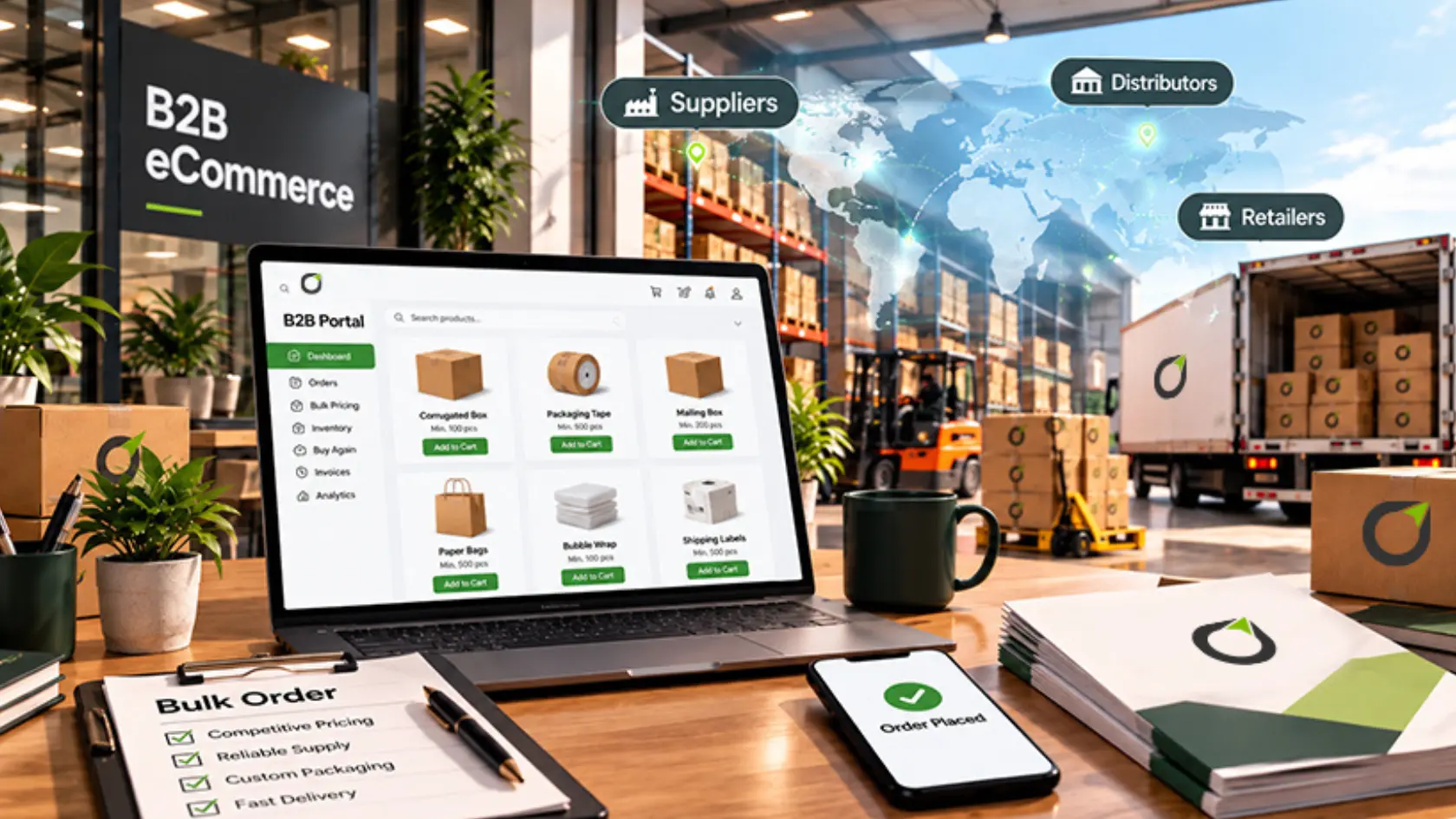
B2B eCommerce (business-to-business eCommerce) is the online sale of goods or services between businesses – such as manufacturers selling to distributors, wholesalers selling to retailers, or brands selling to institutional buyers – through digital platforms, marketplaces, and B2B storefronts. Unlike B2C eCommerce, it typically involves bulk orders, negotiated pricing, longer sales cycles, and complex fulfillment requirements across multiple channels.
This guide breaks down everything a business needs to understand and operate B2B eCommerce successfully: definitions, models, challenges, and the distribution, warehousing, and fulfillment infrastructure that makes it work at scale.
What Is B2B eCommerce?
B2B eCommerce refers to the buying and selling of products or services between two businesses through an online channel, rather than between a business and an individual consumer. Common examples include:
- A manufacturer selling raw materials to a factory through an online portal
- A distributor supplying retail stores via an eCommerce ordering platform
- A brand fulfilling bulk orders to institutional buyers (hotels, hospitals, offices)
- A wholesaler operating a storefront on marketplaces like Daraz for business buyers
B2B eCommerce sits at the intersection of digital commerce and traditional trade distribution – meaning the transaction may start online, but the real complexity lies in what happens afterward: order processing, warehousing, inventory accuracy, and last-mile delivery.
B2B eCommerce vs B2C eCommerce: Key Differences
| Factor | B2B eCommerce | B2C eCommerce |
| Buyer | Businesses, distributors, retailers | Individual consumers |
| Order size | Bulk / high volume | Single unit / small basket |
| Pricing | Negotiated, tiered, contract-based | Fixed, listed pricing |
| Sales cycle | Longer, relationship-driven | Short, impulse-driven |
| Fulfillment | Complex, multi-location, compliance-heavy | Simpler, direct-to-consumer |
| Payment terms | Credit terms, invoicing | Instant payment |
Understanding this distinction matters because B2B eCommerce success depends far more on operational infrastructure – distribution networks, warehousing accuracy, and fulfillment speed – than on storefront design alone.
Types of B2B eCommerce Models
- General Trade Distribution – Selling through traditional retail and distributor networks with order taking, merchandising, and market execution support.
- Modern Trade Distribution – Managing key accounts, listings, and in-store promotions with large retail chains.
- eCommerce Distribution – Selling through pureplay and quick-commerce (Q-commerce) online retailers, including inventory and marketplace account management.
- Marketplace-Based B2B Selling – Operating storefronts on platforms such as Daraz, Shopify, or WooCommerce for business buyers.
Why B2B eCommerce Is Growing
Businesses are shifting from manual, paper-based ordering to digital B2B commerce because it reduces order errors, speeds up replenishment cycles, and gives brands real-time visibility into sell-through data. As more distributors, retailers, and institutional buyers expect the same convenience they get as consumers, B2B eCommerce has become a competitive necessity rather than an optional upgrade.
Key Challenges in B2B eCommerce
Most B2B eCommerce initiatives don’t fail because of the storefront – they fail because of what happens after checkout. The most common challenges include:
- Inventory accuracy across multiple channels (marketplaces, distributors, direct retail)
- Order management complexity when handling bulk, institutional, and distributor orders simultaneously
- Warehousing and compliance, including batch tracking, expiry management, and FIFO/FEFO handling for regulated or perishable goods
- Last-mile and multi-location fulfillment, especially for brands selling on both general trade and eCommerce channels
- Returns and reverse logistics, which are harder to manage at B2B volume than in consumer eCommerce
This is why brands scaling B2B eCommerce operations increasingly partner with dedicated logistics and distribution specialists rather than building everything in-house.
How to Build a Successful B2B eCommerce Operation
- Map your channels first. Identify whether you’re selling through general trade, modern trade, eCommerce marketplaces, or a mix of all three – each requires a different fulfillment model.
- Centralize inventory visibility. Use a system that reconciles stock across warehouses, distributors, and online marketplaces to avoid overselling.
- Standardize warehousing practices. Implement batch management, cycle counts, and quality control checks so every order – general trade or eCommerce – ships accurately.
- Build channel-specific fulfillment workflows. Marketplace orders, distributor bulk dispatches, and institutional orders each have different SLAs and packaging needs.
- Plan for reverse logistics from day one. Returns, damage management, and replacement handling should be built into the process, not added later.
- Use demand forecasting. Route planning, sales reporting, and performance tracking help predict stock needs before shortages happen.
- Partner with an experienced distribution and fulfillment provider if in-house infrastructure can’t scale fast enough.
The Role of Distribution & Fulfillment Partners in B2B eCommerce
Because B2B eCommerce depends so heavily on execution – not just a website – many brands work with third-party logistics (3PL) and distribution partners to manage the full order-to-delivery lifecycle. Rholab is one such distribution and fulfillment partner, supporting brands across the full B2B eCommerce value chain, including:
- Distribution Solutions – general trade distribution, modern trade key account management, eCommerce distribution (pureplay and Q-commerce retailers), and sales operations including route planning and demand forecasting
- Warehousing Solutions – dedicated and shared warehousing, inventory management, cycle counts, batch and expiry management, and FIFO/FEFO compliance
- Fulfillment Solutions – eCommerce fulfillment (pick & pack, packaging, courier coordination, last-mile delivery via rhofleet), marketplace fulfillment (Daraz, Shopify, WooCommerce, multi-channel), B2B fulfillment (distributor, retail, institutional, and bulk dispatches), and reverse logistics
- Value-Added Services – repacking, relabelling, barcode labelling, bundling, gift packs, promotional packaging, and quality inspection
This kind of end-to-end support allows brands to focus on sales and product strategy while the distribution, warehousing, and fulfillment execution is handled by specialists – which is often the difference between a B2B eCommerce channel that scales and one that stalls.
B2B eCommerce Fulfillment: What “Good” Looks Like
A well-run B2B eCommerce fulfillment process typically includes:
- Accurate, real-time inventory sync across all sales channels
- Same-channel-specific packaging (bulk vs. retail-ready vs. institutional)
- Reliable courier and last-mile coordination
- Clear returns and damage-handling workflows
- Marketplace-specific compliance (e.g., Daraz seller requirements, Shopify/WooCommerce order syncing)
Quick Answers
Q1. What is B2B eCommerce in simple terms?
B2B eCommerce is the online buying and selling of goods or services between two businesses – for example, a manufacturer selling to a distributor or retailer – rather than to an individual consumer.
Q2. What is the difference between B2B and B2C eCommerce?
B2B eCommerce involves bulk orders, negotiated pricing, and longer sales cycles between businesses, while B2C eCommerce involves single-unit purchases by individual consumers at fixed prices.
Q3. What are examples of B2B eCommerce platforms?
Examples include B2B-enabled storefronts on Shopify and WooCommerce, marketplace seller accounts on platforms like Daraz, and dedicated distributor ordering portals used in general and modern trade.
Q4. Why is fulfillment more complex in B2B eCommerce?
B2B fulfillment must handle multiple order types at once – bulk distributor dispatches, retail orders, institutional orders, and marketplace orders – each with different packaging, compliance, and delivery requirements.
Q5. Do small businesses need a 3PL for B2B eCommerce?
Not always, but as order volume and channel complexity grow, most businesses benefit from a distribution or fulfillment partner to manage warehousing, inventory accuracy, and last-mile delivery without overextending internal resources.
Q6. What is reverse logistics in B2B eCommerce?
Reverse logistics covers the process of handling returns, damaged goods, and replacements after a B2B order has been delivered, ensuring stock is reconciled and customers are resolved efficiently.
Q7. How does inventory management work in B2B eCommerce?
It involves stock management, cycle counts, stock audits, and inventory reconciliation across all channels – general trade, modern trade, and eCommerce – to prevent overselling or stockouts.
Moving Forward
B2B eCommerce is no longer just about having an online storefront – it’s about building the distribution, warehousing, and fulfillment infrastructure that can support bulk orders, multiple sales channels, and complex compliance requirements at scale. Brands that treat B2B eCommerce as an operational challenge, not just a digital one, are the ones that grow sustainably.
Whether you’re managing general trade distribution, scaling eCommerce marketplace sales, or handling institutional and bulk B2B orders, the right distribution and fulfillment partner can make the difference between a channel that struggles and one that scales smoothly. Rholab supports brands across distribution, warehousing, fulfillment, and value-added services to help B2B eCommerce operations run end-to-end.
Ready to scale your B2B eCommerce distribution and fulfillment? Talk to Rholab about building a distribution, warehousing, or fulfillment solution tailored to your business.