Every business that sells a physical product eventually asks the same question: how do we get this order from our warehouse into the customer’s hands, accurately and on time? The answer to that question is fulfillment – and getting it right is often the difference between a repeat customer and a one-star review.
This guide breaks down what fulfillment actually means, how the process works step by step, the different types of fulfillment businesses use, and how to choose the right fulfillment partner – whether you’re an eCommerce brand, a retailer, or a B2B distributor.
What Is Fulfillment?
Fulfillment is the complete process of receiving, processing, and delivering customer orders – from the moment an order is placed to the moment it’s delivered (and, when needed, returned). It typically includes inventory storage, order picking, packing, shipping, and returns management.
Fulfillment is not just “shipping.” Shipping is one step inside a much larger operational chain that also includes inventory accuracy, quality control, packaging, and last-mile coordination. Businesses that treat fulfillment as a strategic function – not just a back-office task – tend to see fewer delivery errors, faster turnaround times, and stronger customer retention.
At Rholab, fulfillment is treated as one pillar of a broader supply chain system that also covers distribution and warehousing, because in practice these three functions are deeply interconnected: you can’t fulfill an order well if your inventory data or warehouse operations aren’t accurate to begin with.
How Does the Fulfillment Process Work?
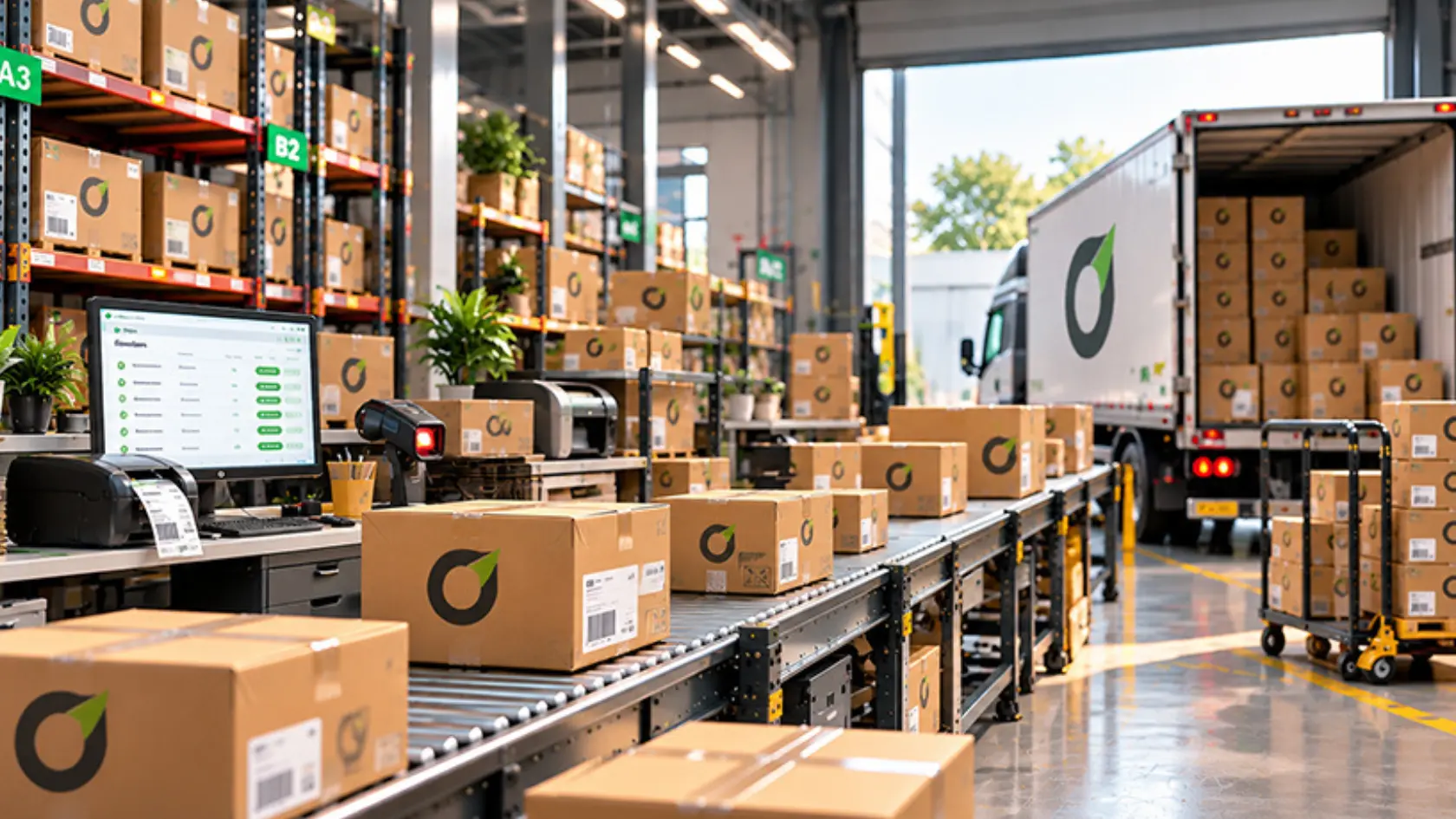
A typical fulfillment process follows six core stages:
- Receiving – Inbound stock is received, inspected, and logged into inventory systems.
- Storage – Products are stored using systems like FIFO (First In, First Out) or FEFO (First Expired, First Out) to maintain quality and reduce waste.
- Order Processing – When a customer places an order, it’s automatically or manually verified against available stock.
- Pick & Pack – Warehouse staff pick the exact items ordered and pack them securely, often with branded or protective packaging.
- Shipping / Courier Coordination – The order is handed to a courier or last-mile delivery partner for dispatch.
- Returns Management (Reverse Logistics) – If a customer returns or exchanges an item, it’s processed, inspected, and either restocked, repaired, or discarded.
Each stage directly affects delivery speed and order accuracy, which is why fulfillment errors – wrong items, late deliveries, damaged packaging – almost always trace back to a breakdown in one of these six steps.
Types of Fulfillment
Different business models require different fulfillment approaches. Here are the main types:
eCommerce Fulfillment
Covers the full journey of an online order: pick and pack, packaging, order processing, courier coordination, returns management, and last-mile delivery. This is the most common fulfillment type for direct-to-consumer (D2C) brands.
Marketplace Fulfillment
Fulfillment tailored to specific online sales channels such as Daraz, Shopify, and WooCommerce, including multi-channel fulfillment for brands selling across several platforms at once. Each marketplace has its own SLAs, packaging rules, and seller-performance metrics, so fulfillment operations need to adapt per channel rather than using a one-size-fits-all process.
B2B Fulfillment
Designed for bulk and business-to-business orders – including distributor fulfillment, retail fulfillment, institutional orders, and bulk dispatches. B2B fulfillment usually involves larger order volumes, pallet-level shipping, and stricter documentation requirements than consumer orders.
Reverse Logistics
The process of handling returns, damage management, and replacement handling. Strong reverse logistics protects margins by recovering resellable stock quickly and reducing shrinkage from mishandled returns.
Fulfillment vs. Warehousing vs. Distribution: What’s the Difference?
These three terms are often used interchangeably, but they serve distinct functions:
| Function | Primary Focus | Example Activities |
| Warehousing | Storing inventory safely and accurately | Stock management, cycle counts, batch/expiry management |
| Fulfillment | Getting the order to the customer | Pick & pack, packaging, courier coordination, returns |
| Distribution | Getting the product to market/retailers | Distributor network management, retail coverage, trade marketing |
In short: distribution moves products into the market, warehousing stores those products correctly, and fulfillment turns a customer order into a delivered package. A business scaling fast usually needs all three working together – which is why providers like Rholab structure their services around distribution, warehousing, and fulfillment as one integrated system rather than isolated services.
Why Fulfillment Matters for Business Growth
- Customer experience: Fast, accurate fulfillment directly drives repeat purchases and positive reviews.
- Cost control: Efficient pick-and-pack processes and optimized packaging reduce shipping and material costs.
- Scalability: Outsourced fulfillment lets growing brands handle order spikes (sales, holidays, marketplace campaigns) without hiring and training in-house teams.
- Channel expansion: Multi-channel and marketplace fulfillment capabilities make it easier to sell on Daraz, Shopify, WooCommerce, and other platforms simultaneously.
- Reduced returns friction: Structured reverse logistics turns returns from a cost center into a controlled, recoverable process.
In-House vs. Outsourced Fulfillment: Which Is Right for You?
In-house fulfillment gives businesses full control over packaging, branding, and process, but requires significant investment in warehouse space, staff, systems, and courier relationships.
Outsourced fulfillment (also called third-party fulfillment or 3PL fulfillment) shifts these operations to a specialized partner. This is typically the better option when a business:
- Is scaling faster than its internal logistics capacity
- Sells across multiple marketplaces or channels
- Needs value-added services like relabelling, bundling, or promotional packaging
- Wants to reduce fixed warehousing costs and convert them into variable, order-based costs
- Requires quality control, batch/expiry management, or compliance-heavy handling (e.g., FMCG, pharma, food)
Companies like Rholab support this shift by offering full-stack fulfillment – including pick & pack, order processing, courier coordination, returns management, and last-mile delivery through Rhofleet – alongside value-added services such as repacking, relabelling, barcode labelling, and quality inspection, so brands don’t need to manage multiple vendors separately.
Key Fulfillment Metrics Businesses Should Track
- Order accuracy rate – percentage of orders shipped with correct items
- On-time delivery rate – percentage of orders delivered within the promised window
- Fulfillment cost per order – total fulfillment cost divided by order volume
- Return rate – percentage of orders returned or exchanged
- Inventory accuracy – how closely system stock matches physical stock
Tracking these consistently helps businesses identify whether fulfillment problems stem from warehousing, packaging, or last-mile delivery – and fix the right part of the chain.
Common Questions, Clear Answers
Q1. What is fulfillment in simple terms?
Fulfillment is the process of receiving, storing, picking, packing, and shipping customer orders – plus handling any returns. It covers everything that happens between “order placed” and “order delivered.”
Q2. What is the difference between fulfillment and shipping?
Shipping is only the transportation step of fulfillment. Fulfillment includes shipping but also covers inventory storage, order picking, packing, quality checks, and returns processing.
Q3. What is order fulfillment in eCommerce?
eCommerce order fulfillment refers to the end-to-end process of managing online orders – pick and pack, packaging, courier coordination, and last-mile delivery – often across multiple sales channels like Shopify, WooCommerce, and marketplaces such as Daraz.
Q4. What is 3PL fulfillment?
3PL (third-party logistics) fulfillment means outsourcing fulfillment operations – storage, pick and pack, shipping, and returns – to an external logistics provider instead of managing them in-house.
Q5. What is B2B fulfillment?
B2B fulfillment handles bulk and business-facing orders, such as distributor fulfillment, retail fulfillment, institutional orders, and large-volume dispatches, which typically differ from consumer orders in packaging, documentation, and delivery requirements.
Q6. How is fulfillment different from warehousing?
Warehousing is about storing inventory accurately and safely. Fulfillment is about turning a specific customer order into a picked, packed, and delivered shipment. Warehousing supports fulfillment but is not the same function.
Q7. Why do businesses outsource fulfillment?
Businesses outsource fulfillment to reduce fixed logistics costs, scale faster during demand spikes, access multi-channel and marketplace expertise, and avoid the complexity of managing warehousing, packaging, and courier coordination internally.
Q8. What is reverse logistics in fulfillment?
Reverse logistics is the process of managing product returns, including returns processing, damage management, and replacement handling – turning returned inventory back into usable or resellable stock.
Let’s Bring It All Together
Fulfillment sits at the center of the customer experience – it’s the operational engine that turns an order into a delivery, and a delivery into customer trust. Whether you’re running a growing eCommerce store, managing multi-marketplace sales, or handling large-scale B2B dispatches, understanding how fulfillment works (and where it connects to warehousing and distribution) is essential to scaling without operational chaos.
For businesses that want to stop firefighting logistics issues and start scaling with a reliable system, partnering with an integrated provider is often the fastest path forward.
Ready to simplify your fulfillment operations? Talk to Rholab’s team about eCommerce, marketplace, B2B, and reverse logistics fulfillment solutions built to scale with your business.