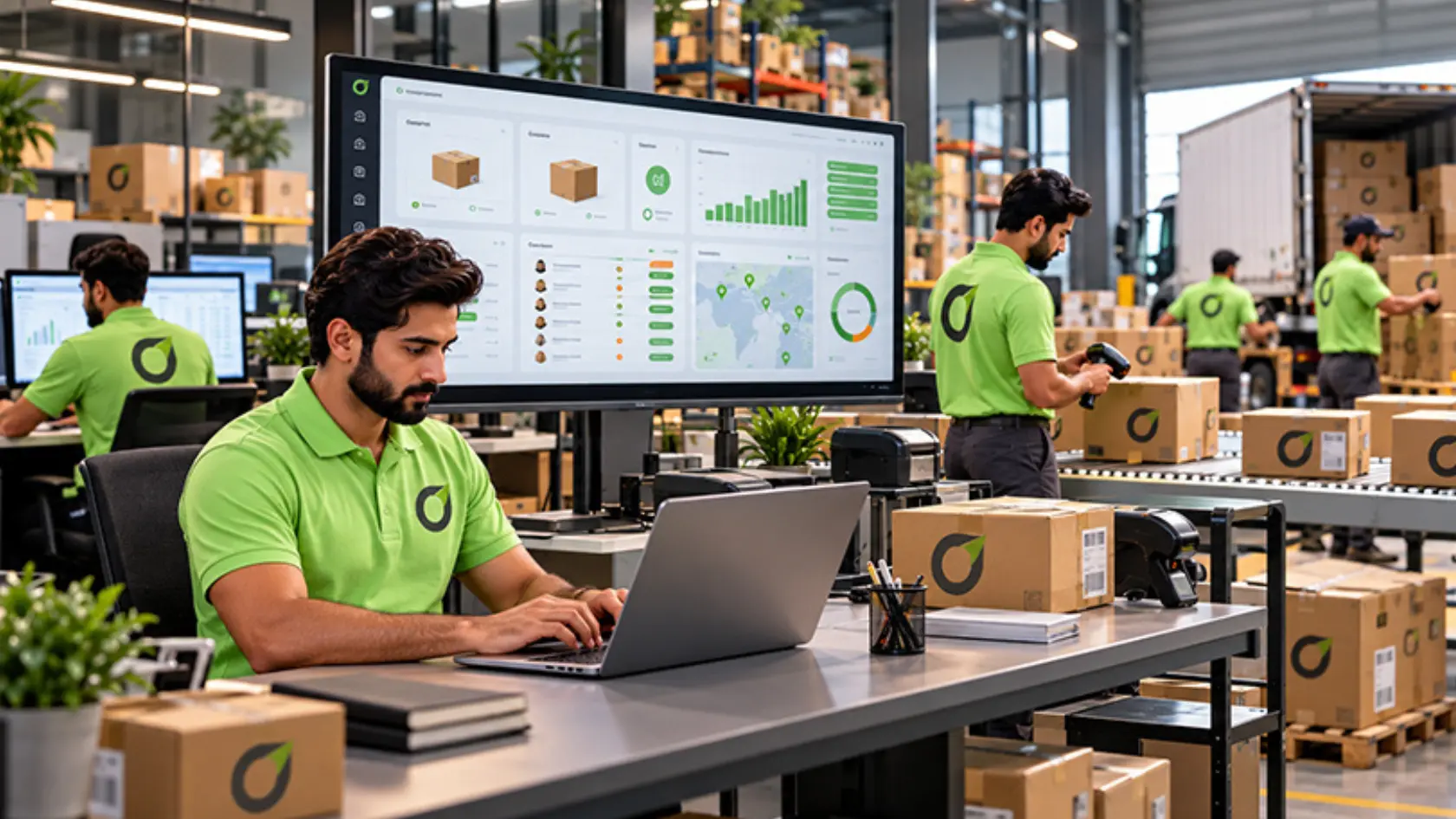
Running an online store on spreadsheets and disconnected apps works for a while – until it doesn’t. Orders pile up across five sales channels, stock counts stop matching reality, and finance can’t close the books because sales data lives in three different places. This is the exact problem an eCommerce ERP solves.
This guide explains what eCommerce ERP is, how it works, the features that matter most, how it compares to standalone tools, and how to choose (or implement) one without disrupting your operations.
What Is an eCommerce ERP?
An eCommerce ERP (Enterprise Resource Planning) is a centralized software system that connects and manages the core operations of an online business – inventory, orders, finance, warehousing, procurement, and customer data – inside a single platform.
Instead of running separate tools for accounting, inventory tracking, and order management, an eCommerce ERP pulls all of that data into one system of record. Every department works from the same real-time information, which removes the manual reconciliation and guesswork that come from disconnected software.
In short: an eCommerce ERP is the operational backbone that connects your storefront, warehouse, sales channels, and financial systems.
Why eCommerce Businesses Need an ERP
As order volume grows, the cracks in a “stitched-together” tech stack start to show:
- Inventory mismatches between what’s listed online and what’s actually in the warehouse
- Order delays caused by manual data entry between systems
- Poor demand forecasting due to fragmented sales history
- Financial reporting lag because sales, cost, and inventory data don’t sync automatically
- Difficulty scaling to new marketplaces, warehouses, or fulfillment partners
An eCommerce ERP addresses these issues by giving every team – sales, warehouse, finance, and customer service – one accurate, real-time source of truth.
Core Features of a Good eCommerce ERP
1. Inventory Management
Real-time stock visibility across warehouses and sales channels, with automated reorder points, batch and expiry tracking, and stock reconciliation.
2. Order Management
Centralized order processing that captures orders from every channel – website, marketplaces, retail, and distributors – and routes them for fulfillment automatically.
3. Warehouse Management (WMS Integration)
Coordination of inbound receiving, putaway, picking, packing, and outbound dispatch, often integrated with or complementary to a dedicated warehouse management system.
4. Financial Management
Automated invoicing, cost tracking, and reconciliation that sync directly with sales and inventory data, reducing manual accounting work.
5. Multi-Channel & Marketplace Integration
Native or API-based connections to platforms like Shopify, WooCommerce, Daraz, and other pureplay and quick-commerce marketplaces, so stock and orders stay synced everywhere at once.
6. Demand Forecasting & Reporting
Data-driven forecasting based on historical sales, seasonality, and channel performance to guide purchasing and production decisions.
7. Supply Chain & Distribution Visibility
End-to-end tracking from supplier to distributor to retail shelf or last-mile delivery.
eCommerce ERP vs. Standalone Tools
| Aspect | eCommerce ERP | Standalone Tools (Spreadsheets, Point Solutions) |
| Data accuracy | Single source of truth, real-time | Manual updates, prone to errors |
| Scalability | Built to handle growth across channels | Breaks down as volume increases |
| Reporting | Automated, cross-department | Manual compilation, delayed |
| Integration | Connects sales, warehouse, and finance | Operates in silos |
| Decision-making | Data-driven, real-time | Reactive, based on outdated info |
An eCommerce ERP isn’t just “more software” – it’s a shift from reactive firefighting to proactive, data-driven operations.
How to Choose the Right eCommerce ERP
When evaluating an eCommerce ERP, prioritize these factors:
- Channel compatibility – Does it integrate with your website platform (Shopify, WooCommerce), marketplaces (Daraz, pureplay and Q-commerce retailers), and POS systems?
- Scalability – Can it handle growth in SKUs, order volume, and warehouse locations without a costly migration later?
- Real-time inventory sync – Does stock update instantly across every channel to prevent overselling?
- Warehouse and fulfillment fit – Does it support batch/expiry tracking, FIFO/FEFO, and multi-warehouse operations?
- Reporting depth – Can it produce demand forecasts and performance dashboards without manual exports?
- Local operational fit – For businesses managing general trade, modern trade, and eCommerce distribution simultaneously, the ERP should reflect how goods actually move through these channels, not just how a typical DTC store operates.
Where Operations Execution Fits In
An ERP is the system of record – but the day-to-day execution still has to happen somewhere: goods need to be stored correctly, orders need to be picked and packed accurately, and last-mile delivery needs to run on time. This is where an operations partner becomes critical alongside the ERP.
This is a core part of how Rholab supports growing eCommerce and distribution businesses. Rholab operates the execution layer that an eCommerce ERP depends on – from eCommerce Distribution (marketplace account management, inventory planning, and order management across pureplay and Q-commerce retailers) to Warehousing Solutions (dedicated and shared warehousing, batch and expiry management, FIFO/FEFO compliance, and inbound-to-outbound processing) to eCommerce and Marketplace Fulfillment (pick and pack, courier coordination, returns management, and last-mile delivery via rhofleet).
In practice, businesses often pair a strong eCommerce ERP for data and decision-making with an operations partner like Rholab for physical execution – inventory storage, order fulfillment across Shopify, WooCommerce, and Daraz, and reverse logistics. The ERP tells you what needs to happen; Rholab makes sure it actually happens on the ground, accurately and on time.
Common Implementation Challenges (and How to Avoid Them)
- Poor data migration – Clean and standardize product, inventory, and customer data before go-live.
- Underestimating training time – Teams need structured onboarding, not just system access.
- Choosing an ERP that doesn’t match warehouse reality – An ERP that ignores batch tracking, expiry management, or multi-channel fulfillment will create more manual work, not less.
- No fulfillment/warehousing partner alignment – An ERP is only as effective as the operations executing against it. Aligning your ERP data flows with your warehousing and fulfillment partner (such as Rholab) prevents disconnects between what the system says and what’s happening on the warehouse floor.
Let’s Answer What You’re Wondering
Q1. What is an eCommerce ERP used for?
An eCommerce ERP is used to centralize and automate core business operations – inventory management, order processing, warehousing, finance, and multi-channel sales – into one connected system, replacing manual spreadsheets and disconnected tools.
Q2. Is eCommerce ERP the same as inventory management software?
No. Inventory management software is typically a single function focused on stock tracking, while an eCommerce ERP is a broader system that connects inventory with orders, finance, warehousing, and reporting across the entire business.
Q3. Do small eCommerce businesses need an ERP?
Not always at launch, but most businesses benefit from an eCommerce ERP once they sell across multiple channels, manage more than a few hundred SKUs, or struggle to keep inventory and order data accurate manually.
Q4. Can an eCommerce ERP integrate with Shopify, WooCommerce, and Daraz?
Yes, most modern eCommerce ERPs offer native integrations or APIs to sync inventory and orders with platforms like Shopify and WooCommerce, as well as marketplaces such as Daraz and other pureplay or Q-commerce retailers.
Q5. What is the difference between ERP and a warehouse management system (WMS)?
An ERP manages business-wide operations including finance, sales, and inventory data, while a WMS focuses specifically on warehouse-floor activities like putaway, picking, and outbound processing. Many businesses use both together, often supported by a fulfillment partner that executes the physical warehouse operations.
Q6. How long does it take to implement an eCommerce ERP?
Implementation timelines vary based on business complexity, but typically range from a few weeks for small catalogs to several months for businesses with multiple warehouses, channels, and legacy data to migrate.
Q7. How does Rholab support eCommerce businesses using an ERP?
Rholab provides the operational execution layer that complements an eCommerce ERP, including warehousing, inventory management, marketplace fulfillment, and last-mile delivery – helping the data in the ERP translate into accurate, on-time execution.
Here’s the Bottom Line
An eCommerce ERP gives growing businesses the single source of truth they need to manage inventory, orders, and finance without the chaos of disconnected tools. But software alone doesn’t move boxes or deliver orders on time – execution matters just as much as the data behind it. Pairing the right ERP with a reliable operations partner is what actually turns real-time data into on-time delivery.
Ready to align your ERP with real-world execution? Talk to Rholab about warehousing, distribution, and fulfillment solutions built to scale with your eCommerce operations. Contact Rholab today →