Q-commerce (quick commerce) is a fast-delivery model of eCommerce in which orders – typically groceries, pharmacy items, and daily essentials – are delivered to customers in under 30 minutes, often from small, hyperlocal fulfillment hubs called dark stores. It combines on-demand technology, dense delivery networks, and micro-fulfillment centers to compress the “order-to-doorstep” window that traditional eCommerce and even standard same-day delivery cannot match.
If you’ve ordered groceries on an app and had them arrive before you finished unpacking your shopping list, you’ve already experienced Q-commerce.
Below, we break down exactly what Q-commerce means, how it works, how it compares to eCommerce, and what brands and retailers need to get right to compete in this space – including the warehousing, distribution, and fulfillment infrastructure behind it.
What Does “Q-Commerce” Mean?
Q-commerce stands for “quick commerce.” It is a subcategory of eCommerce defined by ultra-fast, hyperlocal order fulfillment – generally between 10 and 30 minutes, though some categories (pharmacy, electronics) may stretch to a few hours.
The term is used interchangeably with:
- Quick commerce
- Instant commerce
- On-demand delivery
- Ultrafast delivery
- Rapid delivery commerce
Key entities associated with Q-commerce include dark stores, micro-fulfillment centers, hyperlocal logistics, last-mile delivery, real-time inventory management, and route optimization – all of which work together to shrink delivery windows without sacrificing order accuracy.
How Does Q-Commerce Work?
Q-commerce operates on a fundamentally different logistics model than standard eCommerce. Instead of shipping products from a centralized warehouse hundreds of kilometers away, Q-commerce relies on a decentralized network of small, strategically placed fulfillment points close to the end consumer.
The typical Q-commerce order flow looks like this:
- Order placed – A customer places an order via a mobile app or website.
- Order routed – The system automatically routes the order to the nearest dark store or micro-fulfillment center based on inventory availability and proximity.
- Pick and pack – Warehouse staff pick, pack, and stage the order, often within 2-5 minutes.
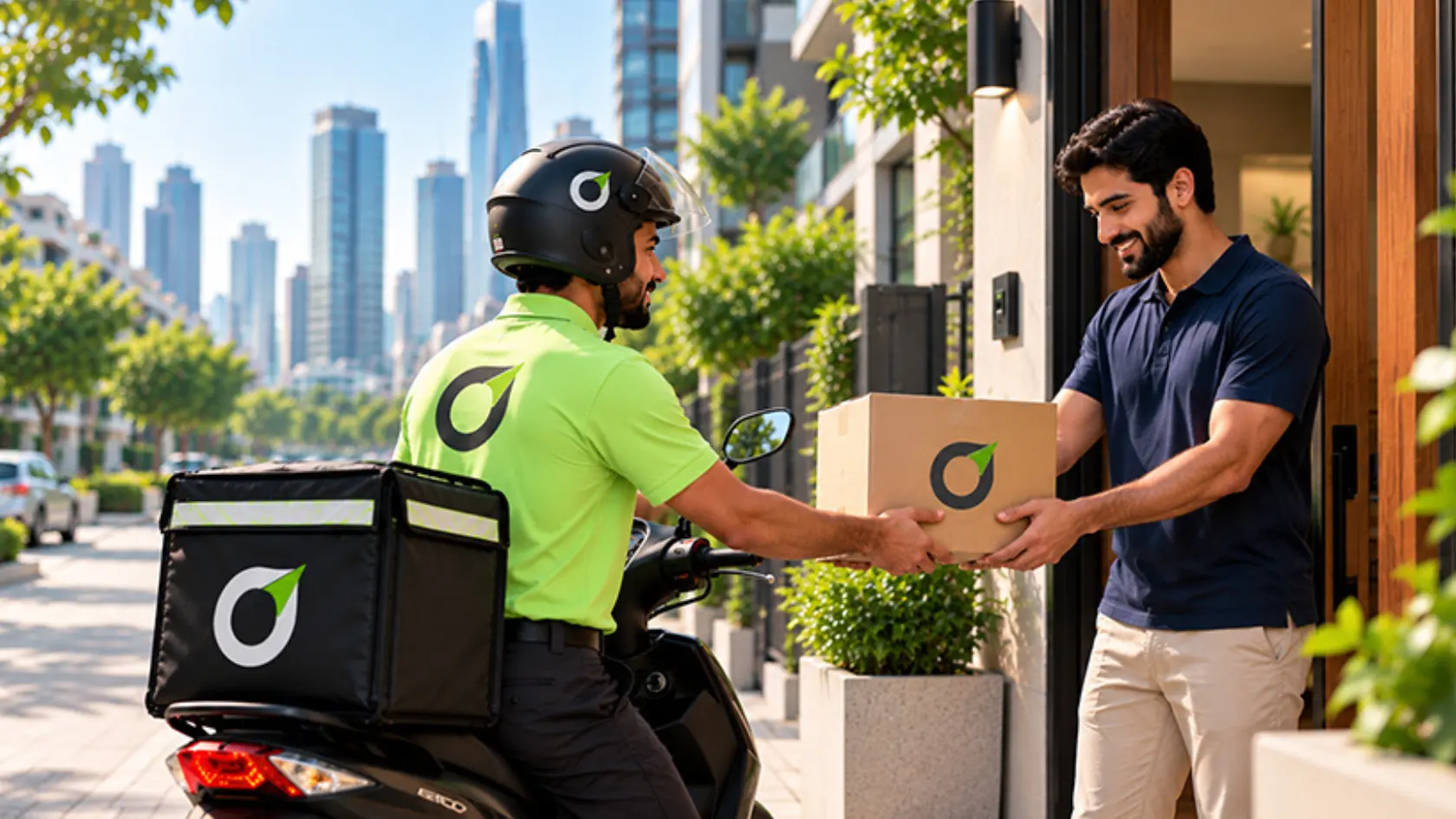
- Last-mile dispatch – A rider or driver is assigned via route optimization software and dispatched immediately.
- Delivery – The order reaches the customer, typically within 10-30 minutes of placement.
This entire cycle depends on accurate real-time inventory data, dense urban warehousing, and tightly managed last-mile logistics – which is why most successful Q-commerce operators either build this infrastructure in-house or partner with a specialized fulfillment and distribution partner to manage it.
Q-Commerce vs. eCommerce vs. Traditional Retail
| Factor | Traditional Retail | eCommerce | Q-Commerce |
| Delivery time | Immediate (in-store) | 1-7 days | 10-30 minutes |
| Fulfillment location | Physical store | Centralized warehouse | Dark stores / micro-fulfillment centers |
| Order catalog | Full range | Full range | Curated, high-frequency SKUs |
| Inventory model | Store-level stock | Bulk, centralized stock | Small-batch, hyperlocal stock |
| Typical categories | All goods | All goods | Groceries, pharmacy, essentials, convenience items |
| Delivery cost per order | N/A | Lower (batched shipping) | Higher (single-order last mile) |
The core distinction is speed enabled by proximity. Q-commerce trades the economies of scale that traditional eCommerce enjoys (bulk shipping, centralized inventory) for a denser, more expensive – but far faster – fulfillment network.
Key Components of a Q-Commerce Business Model
A functioning Q-commerce operation is built on five interconnected pillars:
1. Dark Stores and Micro-Fulfillment Centers
Small, city-embedded warehouses stocked with fast-moving SKUs, positioned within a few kilometers of the customer base they serve.
2. Real-Time Inventory Management
Because delivery promises are measured in minutes, stock accuracy has to be near-perfect. This includes stock management, cycle counts, batch and expiry tracking (especially for FIFO/FEFO-managed categories like food and pharma), and continuous reconciliation.
3. Last-Mile Delivery Network
A dense fleet of riders or drivers, supported by route optimization and live tracking, ensures the final delivery leg is completed within the promised window.
4. Demand Forecasting and Route Planning
Predictive demand forecasting determines what stock should sit in which dark store and when, while route planning keeps delivery fleets efficient during peak hours.
5. Marketplace and Multi-Channel Integration
Many Q-commerce orders originate not just from a brand’s own app, but from marketplaces and quick-commerce retailers (e.g., pureplay and Q-commerce channels), requiring coordinated order management across every channel.
Benefits of Q-Commerce for Brands and Retailers
- Higher customer retention – Instant gratification builds repeat purchase behavior.
- Access to impulse and top-up purchases – Categories like snacks, personal care, and last-minute essentials perform exceptionally well.
- Competitive differentiation – Brands offering Q-commerce availability stand out against competitors limited to next-day delivery.
- Real-time market visibility – Dense, hyperlocal fulfillment generates granular sales and demand data by micro-market.
- New revenue channel – Q-commerce retailers represent a fast-growing order channel alongside pureplay eCommerce and traditional trade.
Challenges in Q-Commerce Fulfillment
Speed is expensive to build and even harder to sustain. The most common operational challenges include:
- High last-mile delivery costs relative to order value, since each order is fulfilled individually rather than batched.
- Inventory accuracy pressure – a single stock-out or mis-pick directly damages the customer promise.
- Warehouse network density – profitable coverage requires enough dark stores to stay close to demand, without over-investing in underutilized locations.
- SKU curation – not every product fits the Q-commerce model; assortment must be optimized for fast-moving, high-frequency items.
- Coordination across multiple retailers – brands selling through several Q-commerce and marketplace retailers need synchronized inventory, order management, and account management to avoid stockouts or overselling.
This is precisely where most brands hit a wall – they can build the demand, but not the fulfillment infrastructure needed to support it at scale.
Q-Commerce Logistics: Warehousing, Fulfillment, and Distribution
Behind every 15-minute delivery is a logistics engine most customers never see. Brands entering Q-commerce typically need support across three interconnected functions:
Warehousing – dedicated or shared storage, inbound and outbound processing, putaway management, batch and expiry management, FIFO/FEFO compliance, cycle counts, and stock audits to keep inventory accurate and audit-ready.
Fulfillment – pick and pack, order processing, packaging, courier coordination, and returns management, tuned specifically for the speed and accuracy Q-commerce demands, including dedicated marketplace fulfillment for platforms and storefronts.
Distribution – eCommerce channel management across both pureplay and Q-commerce retailers, inventory planning, order management, and marketplace account management to keep every channel stocked and synchronized.
Brands that try to manage this in-house from day one often find that dark-store density, real-time inventory syncing, and last-mile coordination require dedicated systems and teams – which is why many partner with a third-party logistics provider that already operates this infrastructure.
How Rholab Supports Q-Commerce Fulfillment
This is where Rholab fits in. As a distribution, warehousing, and fulfillment partner, Rholab helps brands operate across the full Q-commerce supply chain rather than piecing it together channel by channel.
On the distribution side, Rholab’s eCommerce distribution service manages brand presence across both pureplay retailers and Q-commerce retailers – covering inventory planning, order management, and marketplace account management so stock stays available where demand actually happens.
On the warehousing side, Rholab runs dedicated and shared storage with batch and expiry management, FIFO/FEFO compliance, and cycle counts – the accuracy layer that fast delivery promises depend on.
On the fulfillment side, Rholab handles pick and pack, order processing, courier coordination, returns management, and dedicated marketplace fulfillment (including major platforms), plus last-mile delivery through Rhofleet – closing the loop from warehouse shelf to customer doorstep.
And through value-added services like repacking, relabelling, barcode labelling, and promotional bundling, Rholab helps brands tailor products for Q-commerce-specific packaging and promotions without slowing down operations.
In short, Rholab is built to be the operational backbone brands need to compete credibly in the Q-commerce space – without having to build dark-store-level infrastructure from scratch.
The Future of Q-Commerce
Industry research consistently points to sustained double-digit growth for quick commerce over the next several years, driven by expanding dark-store networks, AI-powered demand forecasting, wider category adoption (pharmacy, electronics, personal care), and rising consumer expectations around delivery speed. As the category matures, competitive advantage will shift from “who can deliver fastest” to “who can deliver fast and profitably” – which puts inventory accuracy, warehouse density, and fulfillment efficiency at the center of long-term success.
Curious? Here Are the Answers
Q1. What is Q-commerce in simple terms?
Q-commerce, or quick commerce, is online shopping where orders – usually groceries, pharmacy products, or daily essentials – are delivered within 10 to 30 minutes, using small local warehouses called dark stores instead of large centralized distribution centers.
Q2. What is the difference between Q-commerce and eCommerce?
eCommerce typically delivers orders in one to several days from centralized warehouses, while Q-commerce delivers in minutes using a dense network of hyperlocal dark stores and micro-fulfillment centers positioned close to customers.
Q3. What products are best suited for Q-commerce?
High-frequency, low-involvement products perform best, including groceries, ready-to-eat food, personal care items, household essentials, and pharmacy products – items customers need urgently or buy repeatedly.
Q4. What is a dark store in Q-commerce?
A dark store is a small warehouse or micro-fulfillment center that isn’t open to walk-in customers. It exists solely to store inventory and fulfill online orders quickly for a specific local delivery radius.
Q5. Why is Q-commerce more expensive to operate than eCommerce?
Because each order is fulfilled and delivered individually rather than batched with others, last-mile delivery costs per order are higher, and maintaining a dense network of local warehouses requires more real estate and staffing than one centralized facility.
Q6. How can brands get their products into Q-commerce retailers?
Brands typically need eCommerce channel management, inventory planning, and marketplace account management to list and maintain stock across Q-commerce retailers – functions that logistics and distribution partners like Rholab manage on a brand’s behalf.
Q7. Is Q-commerce profitable?
Profitability varies by market and operator. Success depends heavily on order density, warehouse network efficiency, delivery cost control, and accurate demand forecasting – areas where operational infrastructure and inventory accuracy make the biggest difference.
Let’s Bring It All Together
Q-commerce has moved from a novelty to a core expectation in modern retail. For brands, competing in this space isn’t just about being listed on a fast-delivery app – it’s about having the warehousing, distribution, and fulfillment infrastructure to actually keep that 10-to-30-minute promise, order after order. Getting the fundamentals right – accurate inventory, dense warehousing, synchronized channel management, and reliable last-mile execution – is what separates brands that scale in Q-commerce from those that struggle to keep up.
Ready to get your brand fulfillment-ready for Q-commerce? Talk to Rholab about distribution, warehousing, and fulfillment solutions built specifically for quick commerce.